folding space studio
including the UBC Geographical Computation Lab
What kind of computation for what kind of geography? This question animates the folding space studio. Thought and inquiry across the arts, humanities, and social sciences reach far beyond what is easily computable today. Rather than narrow how we think to fit the histories and interests that produced geographical computing, we try to expand the questions and ways of knowing the digital age is prepared to emphasize.
Computing is already ubiquitous. So are GIS and digital mapping, more specifically. Yet much of how geographers see the world is poorly handled by GIS, or by data science more broadly. Processes, interrelationships, and the social and contextual character of knowledge often end up de-emphasized by how we compute today. We work to make them more of an option in GIS, cartography, and digitally-infused geography more generally.
These questions run through many areas of inquiry: geographic political economy, nature-society relations, agroecology, health and disease, the geohumanities and digital environmental humanities, globalization, sociospatial theory, cartography, and the history of geographic thought. Recent work traces how economy and ecology connect across distance, how landscapes shape the emergence and spread of disease, and how industrial and alternative agricultures differ. Other work asks what maps and data could become if they were built for relational spaces and situated knowledges.
More than a room
The studio is centred at UBC. There it includes the Geographical Computation Lab, in Room 210J of the Geography Building. Yet the studio is more than a physical space. It is also a social and digital space, fostering conversations and collaborations among likeminded people near and far.
Geographic computation here points to the concepts and practices not only of GIS and GIScience, but also of geocomputation, digital geohumanities, spatial big data, critical GIS, STS, and digital geography. It can encompass both cultural critique and technically creative, generative work, theoretical and empirical. Qualitative and ethnographic work is welcome too. Many of these engagements are not limited to geographers.
The interests gathered here are not strictly computational in nature. They do often involve extending how digital approaches are able to express and think with the world. Many of the people in the conversation work on topics not directly related to one another’s, but remain in vigorous intellectual conversation all the same.
Anyone interested in speaking, studying, and/or collaborating with us, please reach out.
digital projects include...
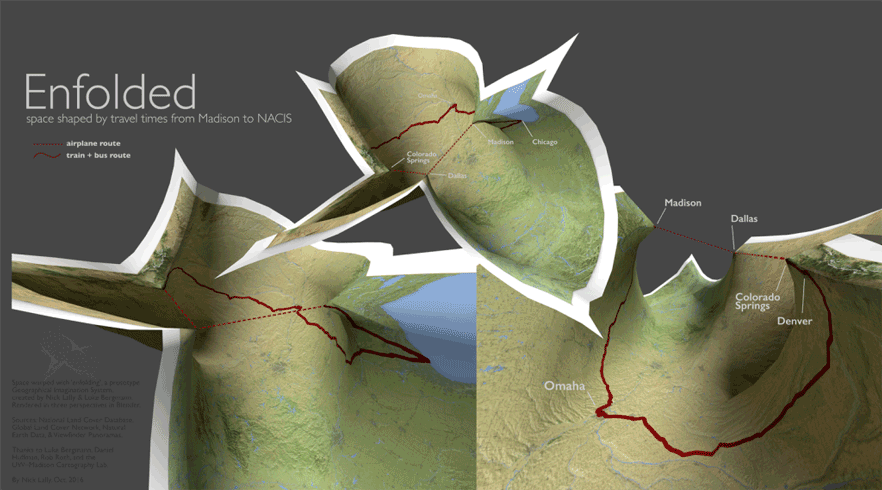
enfolding
A prototype geographical imagination system (gis), made with Nick Lally. It runs in the browser.
William Bunge Archive
Co-curated with Trevor Barnes and others. The archive has supported several of our published papers on Bunge and the history of geographic thought.
Generalized projections
With David O'Sullivan. More projections, more perspectives, more spaces for cartography and GIS.
Weaving space
With David O'Sullivan. Tiled and woven maps that show many attributes of the same places at once.
Interactive widgets
Small web pages for cartography and GIScience.